The AI Frontier in Borneo: Balancing Innovation and Human Talent in Kuching’s Future
DOI:
https://doi.org/10.33736/jbk.13526.2026Keywords:
Regional Context, Workforce Dynamics, SME & Organizational Focus, Artificial Intelligence, Strategic & TheoreticalAbstract
Under the direction of the Sarawak Digital Economy Blueprint and the Post COVID-19 Development Strategy (PCDS 2030), Sarawak is following a strategic roadmap to become a high-income developed state by 2030. This change transforms Kuching into an AI-powered smart city while utilizing digital innovation and artificial intelligence (AI) to upgrade industries like healthcare and agriculture. Advanced infrastructure, such as the Irix Tier IV Data Center and a commitment to 60% renewable energy, support this objective. However, the state is confronted with a "Human Capital Paradox" that is typified by a talent gap of 60% between traditional schooling and the quick advancement of technology. Sarawak has entered a "bootcamp" phase in response to this, with the CENTEXS Digital Academy offering industry-aligned micro-credentialing to guarantee workforce preparedness. A human-centric strategy that gives algorithmic responsibility and data privacy under the Personal Data Protection Act top priority is necessary for effective implementation. In the end, Sarawak's digital frontier prioritizes social inclusivity through rural Digital Community Centers, guaranteeing that technical developments result in fair and sustainable prosperity for all residents.
References
Azizi Othman. (2025). Digital Transformation and AI Adoption in Malaysian SMEs: Opportunities and Barriers.
Boonmee, C., Mangkalakeeree, J., & Jeong, Y. (2025). Towards sustainable digital transformation: AI adoption barriers and enablers among SMEs in Northern Thailand. Sustainable Futures, 10. https://doi.org/10.1016/j.sftr.2025.101169
Islam, A., Islam, M. A., Dal Mas, F., Fijałkowska, J., Rahman, M., & Massaro, M. (2025). Configuring AI-guided sustainable competitive advantage for SMEs through business model innovation: A systematic literature review approach. Journal of Engineering and Technology Management - JET-M, 78. https://doi.org/10.1016/j.jengtecman.2025.101921
Nguyen, D. H. (2025). SENIOR MANAGERS’ GOVERNANCE AND COMMITMENT: DRIVING EMPLOYEE SATISFACTION IN VIETNAM’S GARMENT INDUSTRY AMID TECHNOLOGICAL DISRUPTION. Journal of Governance and Regulation, 14(4 Special Issue), 382–389. https://doi.org/10.22495/jgrv14i4siart14
Post COVID-19 Development Strategy 2030. (2021).
Ramachandaran, S., Mahalley, Z., Nuraini, R., & Dhar, B. K. (2025). Exploring the challenges of AI-driven business intelligence systems in the Malaysian insurance industry. F1000Research, 14. https://doi.org/10.12688/f1000research.163354.1
Sarawak Digital Economy Blueprint 2030. (2023).
WEF. (2023). Shaping the Future of Learning : The role of AI in Education 4.0 : Insight Report.
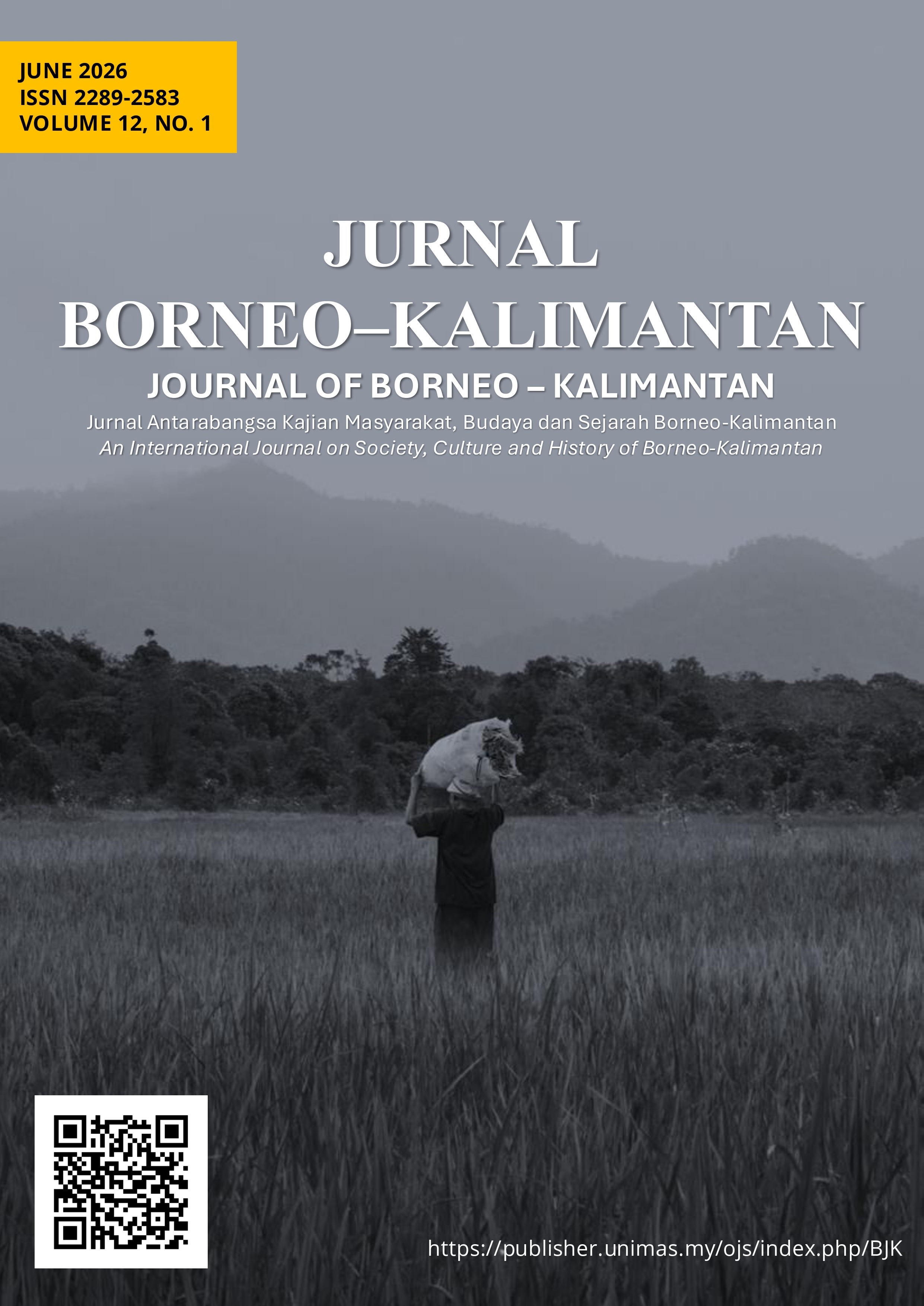
Downloads
Published
How to Cite
Issue
Section
License
Copyright (c) 2026 Journal of Borneo-Kalimantan

This work is licensed under a Creative Commons Attribution-NonCommercial-ShareAlike 4.0 International License.
-
Copyright Transfer Statement for Journal
1) In signing this statement, the author(s) grant UNIMAS Publisher an exclusive license to publish their original research papers. The author(s) also grant UNIMAS Publisher permission to reproduce, recreate, translate, extract or summarize, and to distribute and display in any forms, formats, and media. The author(s) can reuse their papers in their future printed work without first requiring permission from UNIMAS Publisher, provided that the author(s) acknowledge and reference publication in the Journal.
2) For open access articles, the author(s) agree that their articles published under UNIMAS Publisher are distributed under the terms of the CC-BY-NC-SA (Creative Commons Attribution-Non Commercial-Share Alike 4.0 International License) which permits unrestricted use, distribution, and reproduction in any medium, for non-commercial purposes, provided the original work of the author(s) is properly cited.
3) For subscription articles, the author(s) agree that UNIMAS Publisher holds copyright, or an exclusive license to publish. Readers or users may view, download, print, and copy the content, for academic purposes, subject to the following conditions of use: (a) any reuse of materials is subject to permission from UNIMAS Publisher; (b) archived materials may only be used for academic research; (c) archived materials may not be used for commercial purposes, which include but not limited to monetary compensation by means of sale, resale, license, transfer of copyright, loan, etc.; and (d) archived materials may not be re-published in any part, either in print or online.
4) The author(s) is/are responsible to ensure his or her or their submitted work is original and does not infringe any existing copyright, trademark, patent, statutory right, or propriety right of others. Corresponding author(s) has (have) obtained permission from all co-authors prior to submission to the journal. Upon submission of the manuscript, the author(s) agree that no similar work has been or will be submitted or published elsewhere in any language. If submitted manuscript includes materials from others, the authors have obtained the permission from the copyright owners.
5) In signing this statement, the author(s) declare(s) that the researches in which they have conducted are in compliance with the current laws of the respective country and UNIMAS Journal Publication Ethics Policy. Any experimentation or research involving human or the use of animal samples must obtain approval from Human or Animal Ethics Committee in their respective institutions. The author(s) agree and understand that UNIMAS Publisher is not responsible for any compensational claims or failure caused by the author(s) in fulfilling the above-mentioned requirements. The author(s) must accept the responsibility for releasing their materials upon request by Chief Editor or UNIMAS Publisher.
6) The author(s) should have participated sufficiently in the work and ensured the appropriateness of the content of the article. The author(s) should also agree that he or she has no commercial attachments (e.g. patent or license arrangement, equity interest, consultancies, etc.) that might pose any conflict of interest with the submitted manuscript. The author(s) also agree to make any relevant materials and data available upon request by the editor or UNIMAS Publisher.