Rivers and the Penan Landscape
DOI:
https://doi.org/10.33736/jbk.9420.2025Keywords:
Penan, Belaga, Baram, narrative, rivers and streamsAbstract
Keeping clear of polemology or irenology theories and the various explanations tendered about religious reasons for tribal war and headhunting practices, as well as of recent international conflicts, this essay describes the general Borneo setting and the particular situation of the Kapit-and-Baleh region as the meeting point of five of the island’s major river basins. In an attempt to uncover features common to the island as a whole, it first focuses on its heartland, and examines the customs or adat relative to waging war and restoring peace among traditional peoples of the interior. Then, in a diachronic perspective, it tries to figure out how these peoples’ assumed autochthonous methods of conflict prevention and resolution changed across historical periods, from pre-colonial times, insofar as they can be properly identified from both interviews with local people and data from the extant literature; via innovations progressively introduced by contact with and influences from coastal (“Malay”) societies; to the sweeping effect of the colonial states’ administrative policies; and the subsequent powerful impact of modern national (or State) societal practices and legal procedures. While the last phase has led to the local development of new forms of written adat corpuses, this essay also points to some other post-independence developments, and to what may remain today of ancient patterns regarding conflicts, their prevention, and their resolution.
References
Brosius, J. P. (1976), “River, forest and mountains: the Penan Gang landscape.” Sarawak Museum Journal, 36(57): 173-184.
Department of Agriculture. (2020), Projek Sistem Tagang di Sarawak. Agro Kenyalang, 6. <https://doa.sarawak.gov.my/page-0-271-776-Agro-Kenyalang-Magazine.html>.
Langub, J. (2011), “Making sense of the landscape: Eastern Penan perspectives.” Sarawak Museum Journal, 60(90): 79-110.
Langub, J. (2013), “Tamu: institutionalized barter trade, the Penan and their encounter with the colonial and post-colonial state, 44: 178-92.
Needham, R. (1953), The social organization of the Penan: A Southeast Asian people. D. Phil. Thesis, Oxford University.
WWF-Malaysia (2018), The Kuba'an-Puak story: journey towards a green corridor. WWF-Malaysia,
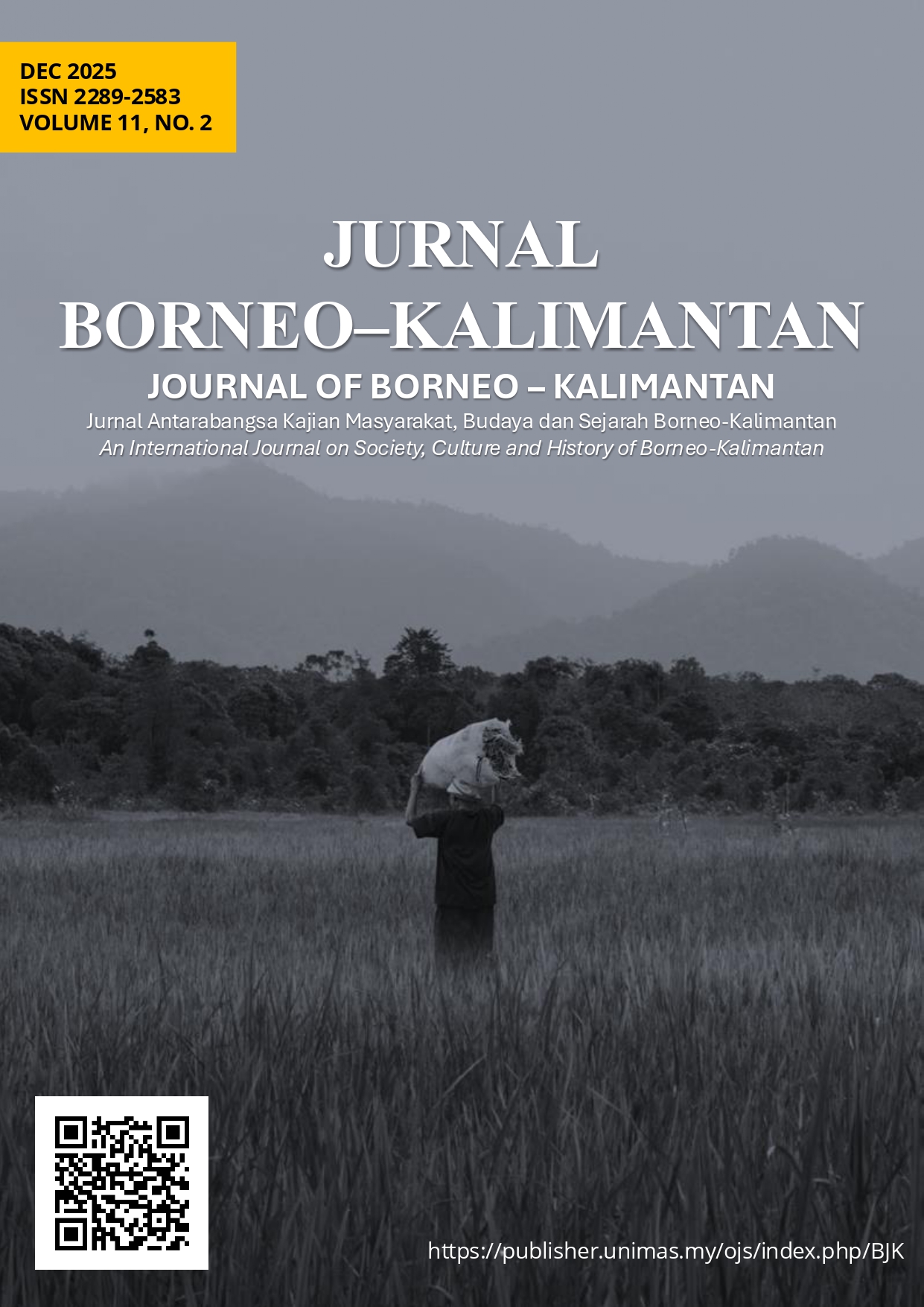
Downloads
Published
How to Cite
Issue
Section
License
Copyright (c) 2025 Jurnal Borneo-Kalimantan

This work is licensed under a Creative Commons Attribution-NonCommercial-ShareAlike 4.0 International License.
-
Copyright Transfer Statement for Journal
1) In signing this statement, the author(s) grant UNIMAS Publisher an exclusive license to publish their original research papers. The author(s) also grant UNIMAS Publisher permission to reproduce, recreate, translate, extract or summarize, and to distribute and display in any forms, formats, and media. The author(s) can reuse their papers in their future printed work without first requiring permission from UNIMAS Publisher, provided that the author(s) acknowledge and reference publication in the Journal.
2) For open access articles, the author(s) agree that their articles published under UNIMAS Publisher are distributed under the terms of the CC-BY-NC-SA (Creative Commons Attribution-Non Commercial-Share Alike 4.0 International License) which permits unrestricted use, distribution, and reproduction in any medium, for non-commercial purposes, provided the original work of the author(s) is properly cited.
3) For subscription articles, the author(s) agree that UNIMAS Publisher holds copyright, or an exclusive license to publish. Readers or users may view, download, print, and copy the content, for academic purposes, subject to the following conditions of use: (a) any reuse of materials is subject to permission from UNIMAS Publisher; (b) archived materials may only be used for academic research; (c) archived materials may not be used for commercial purposes, which include but not limited to monetary compensation by means of sale, resale, license, transfer of copyright, loan, etc.; and (d) archived materials may not be re-published in any part, either in print or online.
4) The author(s) is/are responsible to ensure his or her or their submitted work is original and does not infringe any existing copyright, trademark, patent, statutory right, or propriety right of others. Corresponding author(s) has (have) obtained permission from all co-authors prior to submission to the journal. Upon submission of the manuscript, the author(s) agree that no similar work has been or will be submitted or published elsewhere in any language. If submitted manuscript includes materials from others, the authors have obtained the permission from the copyright owners.
5) In signing this statement, the author(s) declare(s) that the researches in which they have conducted are in compliance with the current laws of the respective country and UNIMAS Journal Publication Ethics Policy. Any experimentation or research involving human or the use of animal samples must obtain approval from Human or Animal Ethics Committee in their respective institutions. The author(s) agree and understand that UNIMAS Publisher is not responsible for any compensational claims or failure caused by the author(s) in fulfilling the above-mentioned requirements. The author(s) must accept the responsibility for releasing their materials upon request by Chief Editor or UNIMAS Publisher.
6) The author(s) should have participated sufficiently in the work and ensured the appropriateness of the content of the article. The author(s) should also agree that he or she has no commercial attachments (e.g. patent or license arrangement, equity interest, consultancies, etc.) that might pose any conflict of interest with the submitted manuscript. The author(s) also agree to make any relevant materials and data available upon request by the editor or UNIMAS Publisher.