Diversity of Land Snail and Slug of Gunung Gading National Park, Sarawak
Keywords:
Diversity, Gunung Gading National Park, inventory, land snails, non-karst areaAbstract
Gunung Gading was officially gazetted as a national park in 1994. Since then, many studies have been conducted to record the diversity of various plants and animals in this area yet the study of terrestrial molluscs remains poorly documented. Therefore, with similar objectives, the first survey was conducted on the diversity of land snails and slugs of Gunung Gading National Park. A survey was conducted from 7th to 11th May 2023 to determine the diversity of land snails and slugs in the vicinity of Gunung Gading. As a result, a total of 540 individuals comprising 20 species of land snails and one species of slug from 19 genera and 10 families have been collected. The study found that the family Cyclophoridae is the most diverse land snail species with a total of six species with 72.59% relative abundance, while the family Helicarionidae and Vallonidae are considered as the least diverse family of land snail with both families comprises of two species with 0.19% relative abundance, respectively. Cyclophorus perdix borneenis is found as the most abundant species with approximately 48.89% of the total number of individuals found. Ecological indices were analysed, comprising species richness (Margalef’s index) = 3.02, diversity index (Shannon-Wiener’s index; H’) = 1.878, dominance index (Simpson’s index) = 0.7257 and evenness index = 0.327. Based on these diversity indices, it indicates that the area has moderate diversity considering it is a non-karst area. Gunung Gading National Park also exhibits a unique ecological dynamic due to its higher species richness but less balanced distribution. These findings provide baseline data for terrestrial molluscs in GGNP as well as contribute to understanding community composition in non‑karst tropical forests and highlight the importance of land snails and slugs in biodiversity and conservation assessments.
References
Adams, A. & Reeve, L.A. (1850). Mollusca. In: Adams A (Ed.), The zoology of the voyage of H.M.S. Samarang, under the command of Captain Sir Edward Belcher, C.B., F.R.A.S., F.G.S., during the years 1843–1846. London, Reeve and Benham. pp. 87.
Aldrich, T.H. (1889). Notes upon a collection of shells from Borneo with description of new species. Journal of the Cincinnati Society of Natural History, 12: 23–25.
Arif, N.A. & Mohd-Azlan, J. (2014). Diversity of birds captured by mist-netting in the understorey of Gunung Gading National Park, Sarawak, Borneo. Kukila, 17 (2): 122–130.
Baker, H.B. (1941). Zonitid snails from Pacific islands. Part 3 and 4. Bernice P. Bishop Museum Bulletin, 166: 203–370.
Benthem Jutting, W.S.S. van. (1952). The Malayan species of Opisthostoma (Gastropoda, Prosobranchia, Cyclophoridae), with a catalogue of all species hitherto described. Bulletin of the Raffles Museum, 24: 5–62.
Benthem Jutting, W.S.S. van. (1959). Catalogue of the non-marine Mollusca of Sumatra and of its satellite islands. Beaufortia, 7: 41–191.
Boonmachai, T., Bergey, E.A., Wongsawad, C. & Nantarat, N. (2024). Influence of limestone and anthropogenic activities on land snail communities in Satun Province, Thailand. Science of the Total Environment, 912, 169372. DOI: 10.1016/j.scitotenv.2023.169372.
Bukhori, M.F.M., Ketol, B., Razali, K.R., Hussain, A. & Rohmon, M.F. (2020). Brief documentation of Basidiomycota and Ascomycota diversity in Gunung Gading National Park, Sarawak. Journal of Science and Mathematics Letters, 8 (1): 37–47. DOI: 10.37134/jsml.vol8.1.5.2020.
Clifford, H.T. & Stephenson, W. (1975). An Introduction to Numerical Classification. Academic Press, New York.
Collinge, W.E. (1901). On the anatomy of a collection of slugs from N. W. Borneo; with a list of the species recorded from that region. Transactions of the Royal Society of Edinburgh, 40: 295–312. DOI: 10.1017/S0080456800034335.
Das, I. & Haas, A. (2005). A new species of Rhacophorus (Anura: Rhacophoridae) from Gunung Gading, Sarawak (Western Borneo). Raffles Bulletin of Zoology, 53 (2): 257–263.
Das, I., Pui, Y.M., Pang, S.T., Taha, W., Martin, T.R., Hertwig, S.T., Haas, A. & Grafe, U. (2017). A Field Guide to the Amphibians of Gunung Gading National Park, Sarawak (Borneo). Kuching: Sarawak Forestry Corporation Sdn. Bhd.
Dunk, J.R., Zielinski, W.J. & Preisler, H.K. (2004). Predicting the occurrence of rare mollusks in northern California forests. Ecological Applications, 14 (3): 713–729. DOI: 10.1890/02-5322.
Férussac, d’Audebard de AEJPF. (1821–1822). Tableaux systématiques des animaux mollusques classés en familles naturelles, dans lesquels on a établi la concordance de tous les systèmes; suivis d’un Prodrome général pour tous les mollusques ou, uviatiles, vivantes ou fossiles. Arthus Bertrand, Paris. pp. 110.
Fulton, H. (1896). XI.—A list of the species of Amphidromus, Albers, with critical notes and descriptions of some hitherto undescribed species and varieties. Annals and Magazine of Natural History, 17 (97): 66–94. DOI: 10.1080/00222939608680326.
Gheoca, V., Benedek, A.M. & Schneider, E. (2021). Exploring land snails’ response to habitat characteristics and their potential as bioindicators of riparian forest quality. Ecological Indicators, 132: 108289. DOI: 10.1016/j.ecolind.2021.108289.
Godwin-Austen, H.H. (1889). On a collection of land-shells made in Borneo by Mr. A. Everett, with descriptions of supposed new species – Part I. Cyclostomacea. Proceedings of the Zoo¬logical Society of London. pp. 332–355.
Godwin-Austen, H.H. (1891). On a collection of land-shells made in Borneo by Mr. A. Everett, with descriptions of supposed new species, part II. Zonitidae and Helicidae. Proceedings of the Zo¬ological Society of London. pp. 22–47.
Godwin-Austen, H.H. (1903). Further description of the animal of Damayantia carinata, Collinge, showing its similarity to D. smithi, Collinge & G.-A., with remarks on this genus of Issel, Collingea of Simroth, and Isselentia of Collinge. Journal of Molluscan Studies, 5 (5): 311–316.
Gould, A.A. (1859). Descriptions of shells collected in the North Pacific exploring expedition under Captains Ringgold and Rodgers. Proceedings of the Boston Society of Natural History, 7: 161–166.
Gould, A.A. (1862). Otia conchologica: descriptions of shells and mollusks, from 1839 to 1862. Boston, Gould and Lincoln.
Graveland, J., van der Wal, R. & van Balen, J. (1994). Poor reproduction in forest passerines from decline of snail abundance on acidified soils. Nature, 368: 446–448. DOI: 10.1038/368446a0.
Gümüş, B.A. (2010). The land snails of Kâhta, Adiyaman, Turkey (Mollusca: Gastropoda: Pulmonata). Munis Entomology & Zoology, 5 (1): 286–289.
Hammer, Ø., Harper, D.A.T. & Ryan, P.D. (2001). PAST: Paleontological statistics software package for education and data analysis. Paleontologia Electronica, 4 (1).
Issel, A. (1874). Molluschi Borneensi – Illustrazione delle specie terrestri e d’acqua dolce reccolte nell’ Isola di Borneo dai Signori G. Doria e O. Beccari. Tipogra (a del R. Instituto SordoMuti, Genova. pp. 366–486. DOI: 10.5962/bhl.title.10704.
Jailan, T.S., Yi, M.C.K., Kaicheen, S.S., Bouard, F. & Mohd-Azlan, J. (2018). Influences of human activities on Malay civet’s (Viverra tangalunga) occupancy in Sarawak. Malaysian Applied Biology, 47 (1): 139–144.
Juřičková, L., Horsák, M., Cameron, R., Hylander, K., Míkovcová, A., Hlaváč, J.Č. & Rohovec, J. (2008). Land snail distribution patterns within a site: the role of different calcium sources. European Journal of Soil Biology, 44 (2), 172-179. DOI: 10.1016/j.ejsobi.2007.07.001.
Kemencei, Z., Farkas, R., Páll-Gergely, B., Vilisics, F., Nagy, A., Hornung, E. & Sólymos, P. (2014). Microhabitat associations of land snails in forested dolinas: implications for coarse filter conservation. Community Ecology, 15 (2), 180–186. DOI: 10.1556/comec.15.2014.2.6.
Khalik, M.Z. & Marzuki, M.E. (2023). Land snails. In Mohd-Azlan, J., Suaidi, M.K. & Das, I. (Eds.), Life from headwaters to the coast: Bako: Biodiversity between land and the sea. Universiti Malaysia Sarawak, UNIMAS Publisher. pp. 53–56.
Krebs, C.J. (1994). Ecology. The experimental analysis of distribution and abundance (4th ed.). Harper Collins, New York. pp. 688.
Laidlaw, F. F. (1932). Notes on Ariophantidae from the Malay Peninsula, with descriptions of new genera. Proceedings of the Malacological Society of London, 20: 80–94.
Lea, I. (1840). Description of nineteen new species of Colimacea. Proceedings of the American Philosophical Society, 1: 173–175. https://www. biodiversitylibrary.org/page/34512892
Lee, J.Y., Nasir, N.S., Marzuki, M.E., Vermeulen, J.J. & Khalik, M.Z. (2024). The land snail fauna of Batu Kudik, isolated limestone outcrop near Simunjan, Sarawak, Malaysian Borneo (Mollusca, Gastropoda). Biodiversity Data Journal, 12: e115556.
Liew, T.S., Phung, C.C., Said, M.A.M. & Hoo, P.K. (2021). Distribution and abundance of the land snail Pollicaria elephas (Gastropoda: Pupinidae) in limestone habitats in Perak, Malaysia. PeerJ, 9: e11886. DOI: 10.7717/peerj.11886.
Liew, T.S., Schilthuizen, M. & Lakim, M. (2010). The determinants of land snail diversity along a tropical elevational gradient: insularity, geometry and niches. Journal of Biogeography, 37 (6): 1071–1078. DOI: 10.1111/j.1365-2699.2009.02243.
Liew, T.S., Schilthuizen, M. & Vermeulen, J.J. (2009). Systematic revision of the genus Everettia Godwin-Austen, 1891 (Mollusca: Gastropoda: Dyakiidae) in Sabah, northern Borneo. Zoological Journal of the Linnean Society, 157 (3): 515–550. DOI: 10.1111/j.1096-3642.2009.00526.x.
Liew, T.S. & Huang, J.T. (2011). The land snail fauna of Eastern Lanjak Entimau (Mollusca: Gastropoda). In Mohamed, H., (2011 Eds.) Lanjak Entimau Wildlife Sanctuary 'Hidden Jewel of Sarawak'. Proceedings of the seminar: Lanjak Entimau Scientific Expedition. Academy of Sciences Malaysia. pp. 287–293.
Martens, E. von. (1867) Die Preussische Expedition nach Ost-Asien, Zoologischer Teil, Zweiter Band. Die Landschnecken. Verlag der Königlichen geheimen Ober-Hofbuchdruckerei, Berlin, pp. 447.
Martens, E. V. (1864). Diagnosen neuer Arten von Heliceen aus dem indischen Archipel. Monatsberichte der Königlichen Preussische Akademie des Wissenschaften zu, Berlin, pp. 264–270.
Marzuki, M.E., Khalik, M.Z., Liew, T.S. & Mohd-Azlan, J. (2019). Land snails. In Mohd-Azlan, J., Tuen, A.A., Tisen, O.B. & Das, I. (Eds.), Life from headwaters to the coast: Gunung Santubong: Where nature meets culture. Universiti Malaysia Sarawak, UNIMAS Publisher. pp. 77–80.
Marzuki, M.E., Liew, T.S. & Mohd-Azlan J. (2021). Land snails and slugs of Bau limestone hills, Sarawak (Malaysia, Borneo), with the descriptions of 13 new species. ZooKeys, 1035 (1). DOI: 10.3897/zookeys.1035.60843.
Mathew, M. (2024). Snails and slugs as silent witnesses: exploring the ecological significance of ecosystem engineers and biodiversity indicators. International Journal of Entomology Research, 9 (4): 137–140.
Metcalfe, W. (1852). An enumeration of species of recent shells, received by W. J. Hamilton, Esq., from Borneo, in November 1850, with descriptions of the new species. Proceedings of the Zoological Society of London, 19, (1851): 70–74. DOI: 10.1111/j.1096-3642.1851.tb01132.x.
Mohd-Ridwan, A.R., Tahir, N.F.D.A., Mohamad Haikal, E., Csorba, G., Görföl, T., Khan, F.A.A. & Mohd-Azlan, J. (2018). Bats assemblage and lunar phase effect on bat activity at mixed Dipterocarp Forest, Gunung Gading National Park, Sarawak, Borneo. Sains Malaysiana, 47 (7): 1349-1357. DOI: 10.17576/jsm-2018-4707-01.
Morgan, J. (1885). Mollusques terrestres et fluviatiles du royaume de Pérak et des pays voisins (Presqu'île Malaise). Société zoologique de France, 10: 353–428. DOI: 10.5962/bhl.part.14300.
Mousson, M.A. (1857). Novitates Zollingerianæ (1). Journal de Conchyliologie, 2 (6): 154–164.
Nasir, N.S., Lee, J.Y., Marzuki, M.E., Vermeulen, J.J., Mohd-Azlan, J. & Khalik, M.Z. (2024). Checklist of land snail species of Gua Rumbang, Sarawak, Malaysian Borneo (Mollusca, Gastropoda), with a description of a new species, Diplommatina rumbangensis sp. nov. ZooKeys, 1198 (2024): 295. DOI: 10.3897/zookeys.1198.116265.
Nunes, G.K.M. & Santos, S.B. (2012). Environmental factors affecting the distribution of land snails in the Atlantic Rain Forest of Ilha Grande, Angra dos Reis, RJ, Brazil. Brazilian Journal of Biology, 72 (1): 79–86. DOI: 10.1590/S1519-69842012000100010.
Nurhayati, P.A., Prasetia, A.G., Nadhira, F.R., Aulia, L.N., Khoiriza, I.N. & Nurinsiyah, A.S. (2023). Species composition of terrestrial gastropods in an urban conservation area: Cibinong Botanical Garden. Earth and Environmental Science, 1271: 012038. DOI: 10.1088/1755-1315/1271/1/012038.
Pfeiffer, L. (1851). Descriptions of forty-three new species of Cyclostomacea, from the collection of Hugh Cuming, Esq. Proceedings of the Zoological Society of London, 19: 242–251. DOI: 10.1111/j.1096-3642.1851.tb01173.x.
Pfeiffer, L. (1855). Descriptions of a new genus and twenty-three new species of Pneumonopoma, from the collection of H. Cuming, Esq. Proceedings of the Zoological Society of London, 23: 101–106.
Pfeiffer, L. (1856). Descriptions of sixteen new species of Pneumonopoma, from the collection of H. Cuming, Esq. Proceedings of the Zoological Society of London, 24: 336–339.
Pfeiffer, L. (1863). Descriptions of thirty-six new land shells, from the collection of H. Cuming, Esq. Proceedings of the Zoological Society of London, 30 (17–18): 268–278.
Phung, C.C., Heng, P.S. & Liew, T.S. (2017). Land snails of Leptopoma Pfeiffer, 1847 in Sabah, Northern Borneo (Caenogastropoda: Cyclophoridae): an analysis of molecular phylogeny and geographical variations in shell form. PeerJ, 5: e3981. DOI: 10.7717/peerj.3981.
Posit Team. (2023). RStudio: Integrated development environment for R. Posit Software, PBC. https://www.posit.co/.
Reeve, L.A. (1851—1854). Monograph of the genus Helix. In: Reeve LA (Ed.) Conchologica Iconica, 7. Reeve & Co., London. pp. 210.
Rost, R. (Ed.). (1886). Miscellaneous papers relating to Indo-China (Vol. 1). Trübner & Company.
Sarawak Government Gazette. (1998). Wild Life Protection Ordinance. Malaysia: Law of Sarawak.
Sarma, K., Tandon, R., Shivanna, K.R. & Ram, H.M. (2007). Snail-pollination in Volvulopsis nummularium. Current Science, 93 (6): 826–831.
Schilthuizen, M., Chai, H.N., Kimsin, T.E. & Vermeulen, J.J. (2003). Abundance and diversity of land-snails (Mollusca: Gastropoda) on limestone hills in Borneo. Raffles Bulletin of Zoology, 51 (1): 35–42.
Schilthuizen, M. (2006). Land snails. In: Hashimoto, Y., Rahman, H. & Maryati, M. (Eds.), Inventory & collection Total protocol for understanding of biodiversity (2nd ed., 167-173). BBEC Publication No. 56, Japan International Cooperation Agency.
Schilthuizen, M., Liew, T.S., Liew, T.H., Berlin, P., King, J.P. & Lakim, M. (2013). Species diversity patterns in insular land snail communities of Borneo. Journal of the Geological Society, 170 (3): 539–545. DOI: 10.1144/jgs2012-014.
Schilthuizen, M. (2017). Land snails and slugs. In Mohd-Azlan, J., Tuen, A.A. & Das, I. (Eds.) Gunung Penrissen: The Roof of Western Borneo: Life from the Headwaters to the Coast. UNIMAS Publisher, Universiti Malaysia Sarawak and Natural History Publications (Borneo). pp. 85–94.
Shannon, C.E. & Weaver, W. (1963). The mathematical theory of communication. University of Illinois Press, Urbana. pp. 117.
Smith, E.A. (1895). On a collection of land-shells from Sarawak, British North Borneo, Palawan, and other neighbouring islands. Proceedings of the Zoological Society of London, 1895: 97–127.
Solem, A. (1964). A collection of non-marine mollusks from Sabah. Sabah Society Journal, 11: 1–40.
Sow-Yan, C. (2022). Biodiversity Record: Kusan snails, Philalanka kusana, in Singapore. Nature in Singapore, 15: e2022012. DOI: 10.26107/NIS-2022-0012.
Stoliczka, F. (1872). On the land shells of Penang Island, with descriptions of the animals and anatomical notes; part first, Cyclostomacea. Journal of the Asiatic Society of Bengal, 41 (2): 261–271.
Stoliczka, F. (1873). On the land-shells of Penang Island, with descriptions of the animals and anatomical notes; part second, Helicacea. Journal of the Asiatic Society of Bengal, 43: 11–38.
Sutcharit, C., Naggs, F., Ablett, J., Van Sang, P., Van Hao, L. & Panha, S. (2019). Notes on the sinistral helicoid snail Bertia cambojiensis (Reeve, 1860) from Vietnam (Eupulmonata, Dyakii-dae). ZooKeys, 885: 1.
Vermeulen, J.J. & Whitten, A.J. (1998). Fauna Malesiana guide to the land snails of Bali. Backhuys Publishers, Leiden. pp. 164.
Vermeulen, J.J. (1999). Notes on the non-marine molluscs of the island of Borneo 9. The genera Cyclophorus, Leptopoma, and Craspedotropis (Gastropoda Prosobranchia: Cyclophori-dae). Basteria, 63 (4/6): 139–163.
Vermeulen, J.J. & Junau, D. J. (2007). Bukit Sarang (Sarawak, Malaysia), an isolated limestone hill with an extraordinary snail fauna. Basteria, 71 (4/6), 209-220.
Vermeulen, J.J. & Liew, T. S. (2022). Land snails and slugs of Sabah and Labuan (Malaysia). Institute for Tropical Biology and Conservation, Universiti Malaysia Sabah, Kota Kinabalu. pp. iii-x, 1–432.
Vermeulen, J.J., Liew, T.S. & Schilthuizen, M. (2015). Additions to the knowledge of the land snails of Sabah (Malaysia, Borneo), including 48 new species. ZooKeys, 531: 1–139. DOI: 10.3897/zookeys.531.6097.
Watters, G.T., Menker, T. & O’Dee, S.H. (2005). A comparison of terrestrial snail faunas between strip-mined land and relatively undisturbed land in Ohio, USA - an evaluation of recovery potential and changing faunal assemblages. Conservation Biology, 126 (2), 166-174. DOI: 10.1016/j.bioco n.2005.05.005.
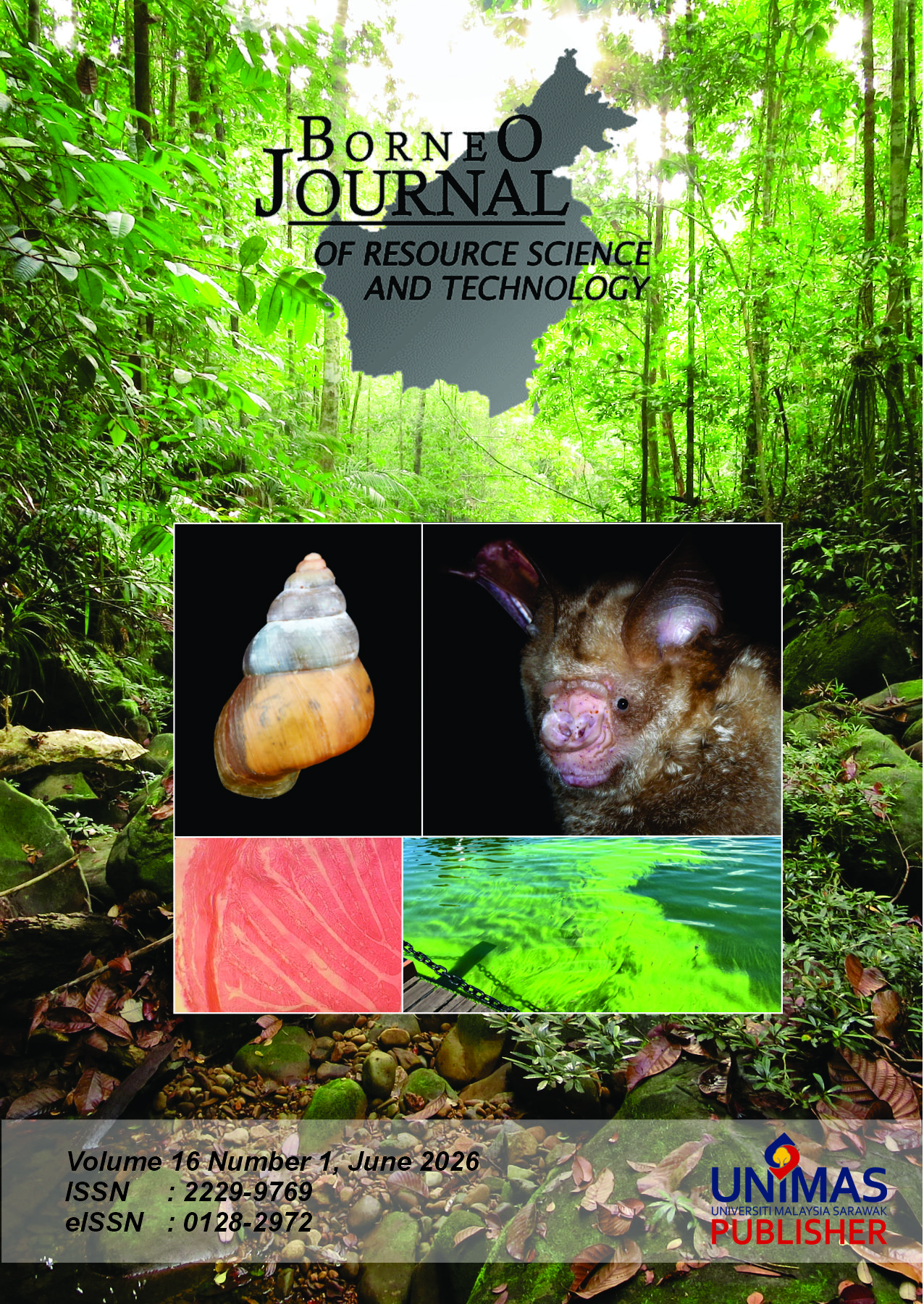
Downloads
Published
How to Cite
Issue
Section
License
Copyright (c) 2026 Borneo Journal of Resource Science and Technology

This work is licensed under a Creative Commons Attribution-NonCommercial 4.0 International License.
Copyright Transfer Statement for Journal
1) In signing this statement, the author(s) grant UNIMAS Publisher an exclusive license to publish their original research papers. The author(s) also grant UNIMAS Publisher permission to reproduce, recreate, translate, extract or summarize, and to distribute and display in any forms, formats, and media. The author(s) can reuse their papers in their future printed work without first requiring permission from UNIMAS Publisher, provided that the author(s) acknowledge and reference publication in the Journal.
2) For open access articles, the author(s) agree that their articles published under UNIMAS Publisher are distributed under the terms of the CC-BY-NC-SA (Creative Commons Attribution-Non Commercial-Share Alike 4.0 International License) which permits unrestricted use, distribution, and reproduction in any medium, for non-commercial purposes, provided the original work of the author(s) is properly cited.
3) For subscription articles, the author(s) agree that UNIMAS Publisher holds copyright, or an exclusive license to publish. Readers or users may view, download, print, and copy the content, for academic purposes, subject to the following conditions of use: (a) any reuse of materials is subject to permission from UNIMAS Publisher; (b) archived materials may only be used for academic research; (c) archived materials may not be used for commercial purposes, which include but not limited to monetary compensation by means of sale, resale, license, transfer of copyright, loan, etc.; and (d) archived materials may not be re-published in any part, either in print or online.
4) The author(s) is/are responsible to ensure his or her or their submitted work is original and does not infringe any existing copyright, trademark, patent, statutory right, or propriety right of others. Corresponding author(s) has (have) obtained permission from all co-authors prior to submission to the journal. Upon submission of the manuscript, the author(s) agree that no similar work has been or will be submitted or published elsewhere in any language. If submitted manuscript includes materials from others, the authors have obtained the permission from the copyright owners.
5) In signing this statement, the author(s) declare(s) that the researches in which they have conducted are in compliance with the current laws of the respective country and UNIMAS Journal Publication Ethics Policy. Any experimentation or research involving human or the use of animal samples must obtain approval from Human or Animal Ethics Committee in their respective institutions. The author(s) agree and understand that UNIMAS Publisher is not responsible for any compensational claims or failure caused by the author(s) in fulfilling the above-mentioned requirements. The author(s) must accept the responsibility for releasing their materials upon request by Chief Editor or UNIMAS Publisher.
6) The author(s) should have participated sufficiently in the work and ensured the appropriateness of the content of the article. The author(s) should also agree that he or she has no commercial attachments (e.g. patent or license arrangement, equity interest, consultancies, etc.) that might pose any conflict of interest with the submitted manuscript. The author(s) also agree to make any relevant materials and data available upon request by the editor or UNIMAS Publisher.